
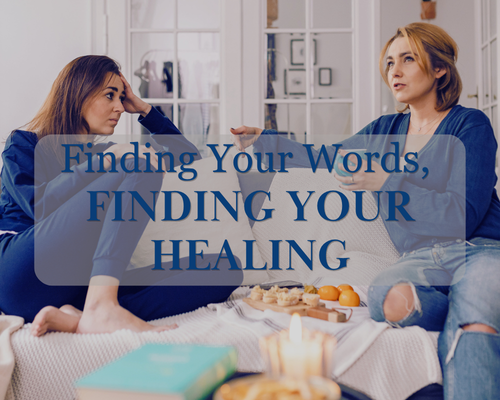
For families loving someone through mental health, behavioral health, or substance use challenges
When someone you love struggles, life can feel like a constant crisis. You may learn clinical language and seek support from National Alliance on Mental Illness (NAMI), Substance Abuse and Mental Health Services Administration (SAMHSA), or Mental Health America (MHA).
Even with knowledge and support, families often carry fear, guilt, anger, grief, or shame. Finding
your words gently breaks that silence — first within yourself, then with others.
Why Words Matter
Repeated crises keep your nervous system in survival mode — tense, alert, and focused on immediate threats. In this state, it’s hard to think clearly or care for yourself. Naming what you feel helps regulate stress.
Instead of thinking “Everything is falling apart,” try:
- “I’m scared of another relapse.”
- “I feel helpless.”
- “I’m grieving the future I imagined.”
Clarity brings steadiness.
Reacting vs. Reflecting
In survival mode, it’s easy to react — fixing, rescuing, suppressing, or acting from urgency.
Words create space to reflect instead:
Reacting
Fixing immediately
Rescuing at any cost
Suppressing emotions
Acting from urgency
Reflection restores choice and steadiness.
Reflecting
Pausing to name your feelings
Considering healthy boundaries
Naming fear, anger, grief
Responding with intention
- “I love you, and I can’t give you money.”
- “I will support treatment, but I won’t lie for you.”
- “I need a break from this conversation.”
Boundaries are protection — not punishment. For more, see Healthy Boundaries vs. Unhealthy Boundaries.
You may think, “They’re the one who’s sick,” or “I have to stay strong.” Loving someone through mental illness or addiction does not erase your humanity — it increases your need for care. You are allowed to say:
- “I am overwhelmed.”
- “I need support.”
- “I love them, and this is exhausting.”
These truths can coexist.
Three-Sentence Check-In:
1. Today I felt…
2. What I needed was…
3. What I’m afraid to say is…
Therapy, counseling, family coaching, or peer support groups can strengthen your capacity to love wisely.
Final Thoughts
Healing isn’t linear — for your loved one or for you. Finding your words doesn’t make you perfect; it makes you conscious.
Your healing matters.
Your nervous system matters.
Your joy matters.
When you find your words, you reclaim yourself — and that is where healing begins.
